

Edge-Grain vs End-Grain: What Actually Matters
When shopping for a solid wood cutting surface, the terms edge grain and end grain are often treated as indicators of quality. In reality, they describe how a board is constructed — and that construction directly affects how the board behaves under a knife, how durable it is, and why prices differ. Understanding these differences helps you make a practical decision without relying on marketing language or assumptions.
The distinction matters because edge grain and end grain are designed to solve different problems in the kitchen. Neither is inherently superior in every situation.
Edge-Grain Boards
Edge-grain boards are made by laminating long strips of wood side by side, with the edges of the boards facing upward. The grain runs lengthwise across the surface, creating a linear, uniform appearance.
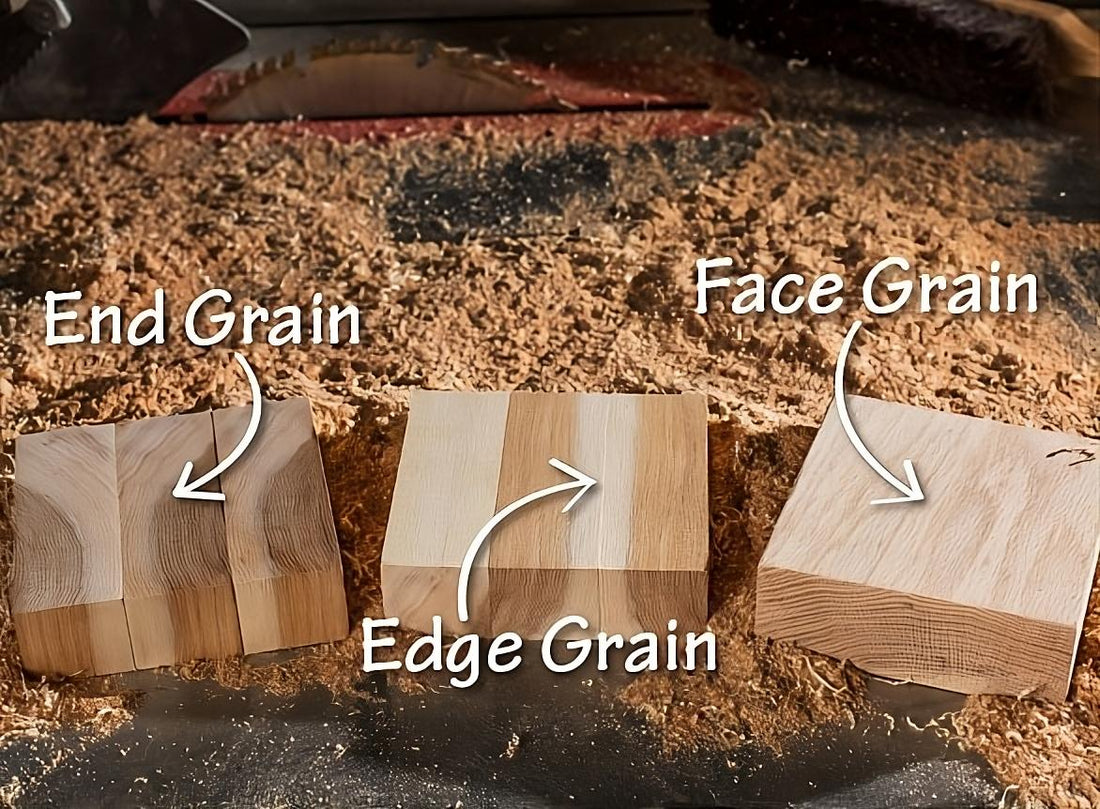
This construction creates a firm, stable cutting surface that performs well for everyday kitchen tasks. Because the wood fibers run horizontally, the knife cuts across the grain rather than directly into it.
In practical use, edge-grain boards:
-
Offer consistent resistance during slicing
-
Are lighter and easier to move and clean
-
Perform well for routine prep tasks
Knife wear on edge grain is predictable and moderate. The surface is not excessively hard, but it does not absorb impact the way thicker constructions do. For slicing vegetables, trimming proteins, and general prep, this balance is appropriate and reliable.
Over time, edge-grain boards will show knife marks. These marks tend to be shallow and evenly distributed rather than deep gouges. With regular oiling, the board maintains stability and resists drying or warping.
From a production standpoint, edge-grain boards require fewer individual cuts and less material thickness. This makes them more efficient to manufacture, which is why they are typically more affordable without sacrificing functional performance.
End-Grain Boards
End-grain boards are constructed by arranging blocks of wood so the ends of the fibers face upward. The surface usually forms a checkerboard or brick-like pattern made from many small sections.
This orientation changes how the board responds to impact. When a knife strikes the surface, the fibers separate slightly rather than resisting the blade head-on. Once the knife is lifted, the fibers close back together.
It’s important to clarify what this means. End-grain boards do not repair themselves, and they are not immune to wear. However, the structure can reduce the appearance of deep knife marks during heavy, repetitive chopping.
In real-world use, end-grain boards:
-
Absorb impact more effectively during forceful cuts
-
Are well suited for repeated heavy chopping
-
Stay stable due to increased thickness and weight
Knife wear may be slower during demanding tasks because the blade encounters less direct resistance. For lighter slicing and everyday prep, the difference is often minimal.
End-grain construction requires more material, more labor, and more assembly time. Boards are typically thicker to maintain strength, which adds weight and cost. Cleaning and oiling also take longer, as the exposed fiber ends absorb more oil.
Common Misunderstandings
A frequent misconception is that end grain is always better for knives. The benefit is most noticeable under heavy, repetitive chopping, not during typical daily prep.
Another misunderstanding is that edge-grain boards are a compromise. For many kitchens, they are simply better suited to how food is prepared most of the time. Ease of handling, cleaning, and storage matter as much as durability.
Price differences are also often misinterpreted. Higher cost reflects material use and labor intensity, not universal superiority.
Choosing Based on How You Cook
The most practical way to choose between edge grain and end grain is to look at how you actually use your cutting surface.
If your prep usually involves:
-
Vegetables, fruit, and herbs
-
Portioning proteins
-
Regular meal prep
An edge-grain board is typically the better fit. It handles these tasks efficiently while remaining easy to maintain and move.
If you frequently do:
-
Heavy chopping with significant force
-
Large-volume prep sessions
-
Repetitive impact-heavy knife work
An end-grain board may be more appropriate due to its mass and impact absorption.
Many kitchens use both, assigning different boards to different tasks rather than relying on one surface for everything.
Different grain constructions suit different roles. Edge grain and end grain are not competing standards — they are construction methods chosen to match how a board is meant to be used.
Choose the Right Construction
Once you understand grain orientation, the next step is selecting a board built for how you cook.